

The problem: urgency can start action, but it cannot sustain it forever
Urgency is one of the strongest forces in social action. When a need feels immediate, people respond quickly. They donate, share information, volunteer, contact friends, and help projects reach goals that seemed impossible only days earlier.
But urgency has a weakness: it is difficult to maintain.
People cannot live permanently in emergency mode. Attention shifts, new problems appear, personal circumstances change, and emotional capacity becomes limited. A campaign that once felt impossible to ignore can gradually become one of many requests competing for the same time, money, and energy.
For nonprofits and community initiatives, this creates an important question: what keeps people involved when the urgency fades?
Very often, the answer is values.
People may discover a project because something urgent happened. They stay because the project represents something they continue to believe in.
Urgency creates a reaction; values create a reason
An urgent message usually asks for a decision now.
A shelter needs food this week. A community space needs repairs before winter. A local initiative needs volunteers before an event. A fundraising campaign has several days left to reach its target.
These situations create clear reasons to act.
But once the immediate need is resolved, the emotional trigger disappears. If the relationship between the person and the initiative was built entirely around that trigger, participation may disappear too.
Values work differently.
Someone who cares about animal welfare may donate to one emergency campaign but remain interested in animal shelter support long afterward. A person who believes that neighborhoods should be safer and more connected may first join a cleanup but later support another local initiative. Someone interested in equal access to education may contribute money once and offer professional skills later.
The original action changes. The underlying motivation remains.
That is what makes values powerful.

People need to understand what a project stands for
A social initiative naturally explains what it does. But long-term community engagement also depends on explaining why the work matters beyond the current task.
Consider the difference between these messages:
“We need volunteers to renovate this community space.”
and:
“We want people in this neighborhood to have a place where they can meet, organize activities, exchange ideas, and feel connected.”
The first explains the task. The second explains the value behind it.
Both are necessary.
Without a practical request, people do not know how to help. Without a broader meaning, participation can feel temporary.
Projects become easier to identify with when people can recognize the principles behind their actions: dignity, mutual support, accessibility, responsibility, transparency, care, inclusion, or local ownership.
Those principles give individual activities a common direction.
Values make different forms of participation feel connected
Long-term supporters rarely participate in exactly the same way forever.
Someone may donate during one campaign, volunteer during another, disappear for several months, and later return with a useful contact or professional skill.
From a purely transactional perspective, these actions can look unrelated.
From a values-based perspective, they are part of the same relationship.
This is especially important for modern social impact initiatives because people need flexibility.
Participation might mean:
- making a small financial contribution;
- completing a micro-volunteering task;
- joining online volunteering;
- offering professional expertise;
- helping organize an activity;
- sharing a project with the right audience;
- giving feedback;
- contributing materials, equipment, or another resource.
These ways to help without money allow people to remain connected even when their financial or personal capacity changes.
The form of participation becomes flexible while the reason for participating remains stable.
Shared values create stronger communities
A group of donors is not automatically a community.
Neither is a list of volunteers.
Community begins to emerge when people understand that others around them care about something similar.
That recognition changes participation.
Instead of thinking, “I made a donation to this campaign,” a person may begin thinking, “I am part of a group trying to improve this situation.”
It is a subtle shift, but an important one.
Shared values can create a sense of belonging even among people who contribute very differently. One person may have more time. Another may have professional expertise. Someone else may only be able to donate occasionally.
They do not need identical roles.
They need a shared understanding of what they are working toward.
Values reduce dependence on emotional pressure
Some fundraising communication relies heavily on guilt, fear, or urgency because these emotions can generate immediate responses.
The problem appears when they become the default strategy.
If every message tells people that they must act immediately or something terrible will happen, supporters eventually become emotionally exhausted. Some stop opening updates. Others begin feeling that whatever they contribute will never be enough.
This can weaken both fundraising and trust.
Values-based communication creates another path.
It can say:
Here is the problem.
Here is why we believe it matters.
Here is what we are doing.
Here is what has already changed.
Here is where your participation can help.
The need remains clear, but the person is given agency rather than pressure.
For crowdfunding for good, this distinction matters. Sustainable fundraising depends not only on convincing people to give once but also on creating a relationship they are willing to return to.
Visible progress turns values into something concrete
Values can become too abstract if people never see them translated into action.
A project may talk about inclusion, community, care, or sustainability, but supporters eventually need evidence that those ideas influence actual decisions.
Progress makes values visible.
If transparency matters, show where the project stands.
If community participation matters, show how people contributed.
If accessibility matters, explain how barriers were reduced.
If shared responsibility matters, show how volunteers and supporters became part of the process.
This is where digital tools for nonprofits can play an important role. Nonprofit technology should not only process donations or manage volunteer registrations. It can also help projects show the connection between participation and outcomes.
When people can follow that connection, values stop being slogans.
They become observable behavior.
Consistency matters more than perfect messaging
People notice when an organization talks about one value but behaves according to another.
A project may describe itself as community-led but rarely listen to participants. It may emphasize transparency while disappearing after fundraising ends. It may celebrate volunteers publicly while giving them unclear tasks and unrealistic expectations.
Trust weakens when values exist only in communication.
The opposite is also true.
Small, consistent behaviors can strengthen credibility:
- explaining when plans change;
- publishing progress even when it is slower than expected;
- respecting volunteer boundaries;
- responding to useful feedback;
- acknowledging different forms of contribution;
- communicating clearly about current needs.
None of these actions are dramatic.
Together, they show people what kind of community they are participating in.
Values can protect participation from burnout
Burnout is not only caused by doing too much. It can also come from feeling that effort has lost meaning.
People are more likely to become exhausted when they cannot see why their work matters, when expectations constantly increase, or when participation feels like an endless series of emergencies.
Values provide context.
A volunteer who understands the broader purpose of a task can see how even a small contribution fits into something larger. A donor who receives meaningful updates can understand why continued support matters. A community member who sees progress can recognize that participation is producing change.
But values should never become another reason to pressure people.
Believing deeply in a cause does not mean someone must contribute constantly.
Healthy community engagement allows people to step back, return later, change roles, and contribute according to their capacity.
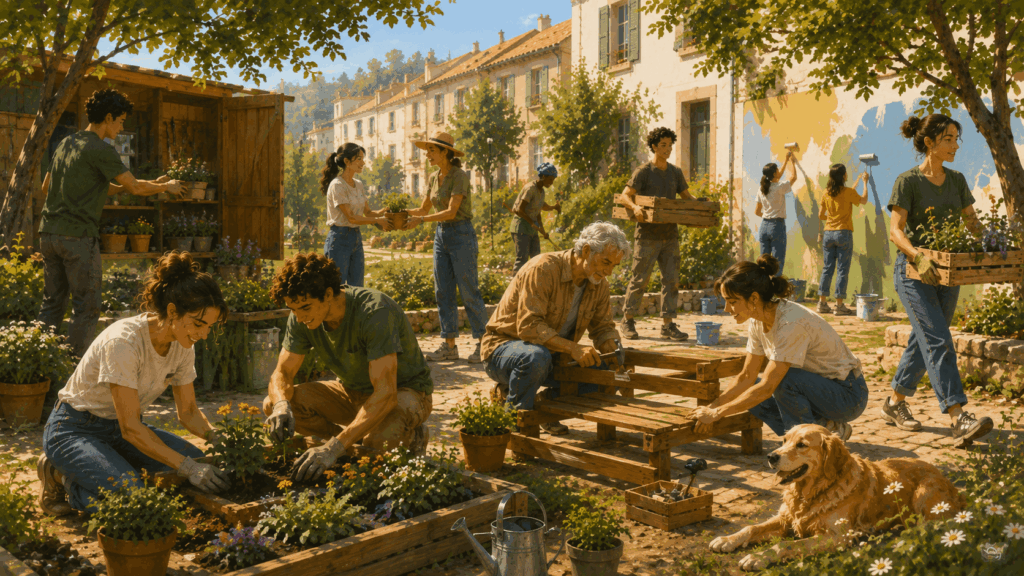
Strong projects make values visible in their structure
The most convincing way to communicate values is to build them into how the project works.
If a project values accessibility, participation should be easy to understand.
If it values transparency, supporters should be able to follow progress.
If it values collaboration, people should have meaningful ways to contribute beyond donating.
If it values sustainability, volunteers should not be expected to operate permanently at maximum intensity.
This is where project design becomes part of communication.
People learn what an initiative believes by experiencing how it treats them.
Deya can help connect values with action
Deya brings crowdfunding, volunteering, project updates, and community participation into one environment.
That structure allows projects to offer more than a single transactional interaction.
A person might discover an initiative through crowdfunding for good and later participate through online volunteering. Someone who cannot contribute financially might find a micro-volunteering task that matches their skills. Another supporter might follow progress and return when a new need appears.
Different actions can remain connected to the same purpose.
For organizers, this creates an opportunity to communicate not only what they need today but also how the project develops over time. Updates, new stages, volunteer opportunities, and community participation can show how the initiative’s values translate into actual work.
The technology does not create those values.
It gives projects another way to make them visible.
Long-term impact grows from identity, not constant urgency
Urgency will always have a place in social impact.
Some situations genuinely require immediate action. Communities need ways to mobilize quickly when circumstances demand it.
But urgency should be a moment, not the entire relationship.
If people only participate when the emotional pressure is high enough, organizations must constantly recreate that pressure.
If people understand the values behind the work, something different becomes possible.
They can remain connected between campaigns.
They can contribute in different ways.
They can return after periods of inactivity.
They can recommend the project because they trust what it represents, not only because one request happens to be urgent.
Over time, this creates a more resilient form of participation.
What remains after the urgent moment passes
A fundraising deadline eventually ends. A volunteer event finishes. An emergency need is resolved or changes. Attention moves somewhere else.
The question is what remains.
If the project built only urgency, very little may be left once that urgency disappears.
But if people discovered a community whose values they recognize, the relationship can continue.
They may not contribute every week. They may not participate in every campaign. Their role may change repeatedly.
What matters is that they still understand why the work deserves to exist.
That is the difference between temporary mobilization and lasting social impact.
Urgency can bring people to a project.
Clear values, visible progress, trust, and meaningful participation give them reasons to stay.
Deya helps connect crowdfunding for good, online volunteering, micro-volunteering, and community engagement so that participation can continue beyond a single urgent moment.
Deya is not just technology. It is a way to help - conveniently, transparently, and meaningfully.