

The problem: local needs are urgent, but support is uneven
Local initiatives often emerge from immediate, visible needs.
A community center requires repairs.
A neighborhood launches an animal shelter support effort.
A small nonprofit begins a crowdfunding for good campaign to fund essential services.
These projects are grounded in proximity. They serve real people in specific places.
But support does not always come from the same geographic area.
Some communities lack sufficient local funding.
Some volunteer bases are small.
Some initiatives depend on seasonal engagement.
Meanwhile, many individuals who care deeply about social impact live elsewhere - in different cities, regions, or even countries.
The gap is not emotional. It is structural.
How can remote supporters meaningfully contribute to local projects without weakening accountability or transparency?
This is where remote participation becomes not a secondary option, but a strategic advantage.
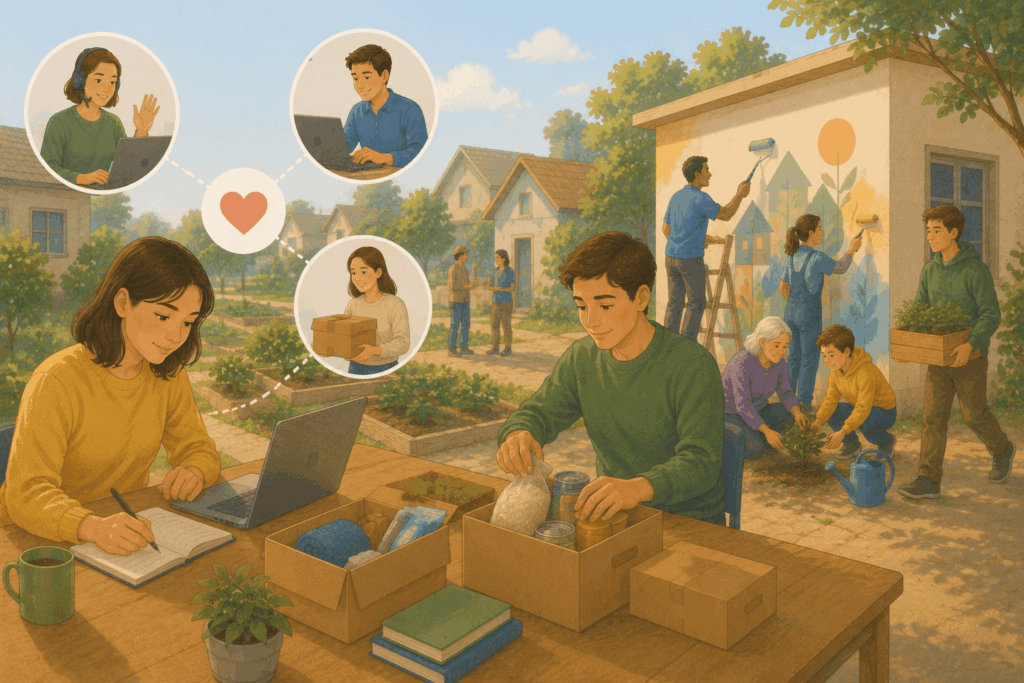
Rethinking proximity in the digital age
For decades, community engagement relied on physical presence.
Volunteering meant showing up.
Fundraising meant local events.
Coordination meant in-person meetings.
Today, nonprofit technology has transformed that landscape.
Remote contributions - whether financial, skill-based, or operational - can strengthen local initiatives when structured correctly.
Online volunteering enables expertise sharing across borders.
Micro-volunteering allows short-term tasks to be completed remotely.
Recurring donations stabilize projects regardless of geographic distance.
Distance no longer prevents participation. It reshapes it.
Why remote contributions increase resilience
Local projects often face unpredictable challenges:
- Sudden funding gaps
- Volunteer shortages
- Seasonal fluctuations
- Emergency expenses
Remote contributors diversify support networks.
When funding and volunteer engagement extend beyond a single location, projects become more resilient.
For example:
- A local animal shelter support initiative may receive recurring micro-donations from supporters in other cities.
- A small nonprofit can recruit remote designers, translators, or communications volunteers through online volunteering channels.
- A grassroots fundraising campaign can expand its crowdfunding for good reach through digital sharing.
Remote participation does not replace local effort. It reinforces it.
The power of skill-based online volunteering
Not all contributions are financial.
Many remote supporters bring specialized skills:
- Graphic design
- Copywriting
- Legal consultation
- Marketing strategy
- Data analysis
- Technical support
For local nonprofits with limited budgets, accessing such expertise locally may be difficult.
Digital tools for nonprofits can connect these skills to projects efficiently.
Micro-volunteering tasks allow professionals to contribute without long-term commitments. Even a few hours of structured support can improve communication clarity, fundraising outcomes, or operational efficiency.
When remote expertise strengthens local infrastructure, sustainability improves.
Transparency builds trust across distance
One of the biggest concerns with remote contributions is accountability.
When supporters are not physically present, they rely entirely on transparent systems.
They need to see:
- Clear funding targets
- Defined milestones
- Visible progress updates
- Documented outcomes
Without structured transparency, distance creates uncertainty.
With structured transparency, distance becomes irrelevant.
Deya’s integrated ecosystem supports this clarity by combining crowdfunding for good, micro-volunteering, and milestone tracking in one place.
Supporters can observe progress without relying on fragmented communication.
Transparency sustains trust across geography.
Making remote participation meaningful
Remote engagement must feel connected to real outcomes.
This requires:
Clear role definition
Remote volunteers should understand exactly how their contribution supports the initiative.
Visible impact
Progress tracking should demonstrate how remote support influences milestones.
Ongoing communication
Updates maintain alignment and engagement.
For example, in a local environmental initiative, remote contributors might:
- Develop communication materials
- Manage digital outreach
- Analyze fundraising data
- Support online community moderation
These roles, when structured clearly, create direct impact.
Clarity transforms remote action into tangible contribution.
Remote support and recurring stability
Recurring contributions are especially valuable for local initiatives.
Even small monthly donations can stabilize operating budgets.
When remote supporters commit to recurring contributions, projects gain:
- Predictable cash flow
- Reduced reliance on emergency appeals
- Long-term planning capacity
Crowdfunding for good campaigns often experience spikes during emergencies. But sustainability requires consistency.
Deya’s platform enables recurring participation within a structured nonprofit technology environment, helping local initiatives balance urgency with stability.
Remote contributors become long-term partners rather than one-time donors.

Lowering barriers to entry
Remote engagement also expands access.
Many people want to contribute but cannot participate physically due to:
- Geographic distance
- Work schedules
- Care responsibilities
- Health limitations
Online volunteering and micro-volunteering lower these barriers.
Ways to help without money - such as content creation, translation, or digital coordination - allow supporters to participate meaningfully from anywhere.
This inclusivity strengthens community engagement beyond local boundaries.
Communities become networks rather than isolated groups.
Avoiding fragmentation
However, remote contributions require coordination.
If fundraising happens on one platform, volunteering on another, and updates on a third, supporters may lose clarity.
Fragmentation weakens trust.
Integrated digital tools for nonprofits are essential to prevent this.
Deya centralizes fundraising, volunteering, and communication, allowing local initiatives to maintain coherence while welcoming remote participants.
When all components align within one ecosystem, distance does not dilute accountability.
Strengthening local identity through global support
Remote contributions do not erase local identity.
In fact, they can amplify it.
When transparent systems show how a local initiative operates, remote supporters feel invited into a specific community story.
They understand:
- The local context
- The defined goals
- The measurable progress
This connection transforms remote participation from abstract charity into relational engagement.
Deya’s structured transparency allows local initiatives to retain authenticity while expanding support networks.
From local action to distributed impact
When multiple local initiatives adopt integrated nonprofit technology, their combined reach expands.
Each project remains locally grounded.
Each supporter, whether local or remote, contributes within a structured framework.
Each milestone is visible.
Distributed support networks increase resilience across communities.
Remote contributions do not replace local responsibility. They multiply its capacity.
Local initiatives remain the heart of social change.
But in a connected world, support no longer needs to be limited by geography.
When remote participation is structured, transparent, and integrated, it strengthens - rather than dilutes - local impact.
If you want to build a local initiative that welcomes remote contributions without sacrificing clarity or trust, explore how Deya supports integrated, transparent community development.
Deya is not just technology. It’s a way to help - conveniently, transparently, and genuinely.